
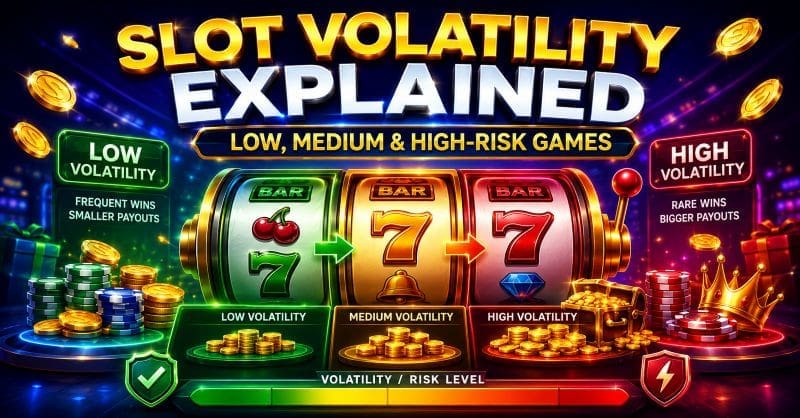
In many ways, the key to avoiding confusion about Volatility is understanding that Volatility represents the overall pattern of how wins are made available in a particular game. To explain, let’s break down each of the major types of Volatility and how they differ from one another in terms of payout frequency and potential win amount. Each game has its own unique “pacing” – this refers to how quickly you receive wins, and how frequently you will encounter a winning outcome.
Low Volatility Slots:
Low-Volatility Slots create small wins fairly regularly. They make up for lower-than-average max wins with a consistent flow of winnings. For example, Starburst has a very low Volatility and a maximum win of approximately 500x stake. As such, it provides a great starting point for beginners who wish to learn the basics of a slot machine without risking excessive funds. Since the wins occur fairly regularly, you can see your Bankroll growing steadily throughout the course of your playtime. This is particularly good for new players since it allows you to build confidence without burning through your Bankroll in short order.
Medium Volatility Slots:
While Slots with medium Volatility may offer less frequent wins compared to Slots with low Volatility, they provide more opportunities to score big. Medium-Volatility Slots give you enough small wins to keep your session exciting, yet hold back occasionally for a truly large payout that can significantly alter the direction of your session. Many seasoned slot enthusiasts find themselves gravitating towards medium-Volatility Slots for this reason. Examples of medium-Volatility Slots include Sweet Bonanza (maximum win = 21,100x), and Reactoonz (maximum win = 4,570x). These examples illustrate that “medium” Volatility is simply a euphemism for “big wins happen less frequently.”
High Volatility Slots:
High-Volatility Slots are designed specifically to provide big wins after prolonged periods of time with no significant activity. In essence, they are perfect for players who enjoy taking calculated risks and don’t mind playing through a cold streak in pursuit of potentially life-changing jackpots. Wanted Dead or Alive from Hacksaw Gaming is an example of a high-Volatility slot with a maximum win of approximately 12,500x. On the other hand, San Quentin from No Limit City offers extreme Volatility with a maximum win reportedly reaching up to 150,000x. Mental from No Limit City comes in second with a maximum win of approximately 66,666x.
Volatility vs. RTP: What is the Difference between these Two terms?
Many players confuse these Two terms; however, they refer to fundamentally different concepts. RTP (return-to-player) is a mathematical estimate representing the percentage of all wagers placed on a specific game that the game will ultimately return to players over time. Conversely, Volatility is concerned with how those returns are dispersed. For instance, it is possible for Two Slots with identical RTPs (i.e., 96%) to be perceived as having vastly different Volatility profiles. An RTP-focused perspective implies that the Two Slots would yield similar returns, albeit possibly at different rates. However, one slot could award numerous small wins in rapid succession (e.g., low Volatility), whereas the other slot may withhold virtually all returns until a single massive win occurs (extreme Volatility).
Volatility vs. RTP: What is the main Difference?
RTP stands for return-to-player
It is a measure of how much money an online casino expects to pay back to players in the long run.
RTP is measured as a percentage.
For example:
A 95% RTP means that $95 in bets will result in $95 returned to players.
A 98% RTP means that $98 in bets will result in $98 returned to players
Volatility
Volatility refers to how volatile a game is.
Games can be classified as low, medium or high volatility depending on how much variation exists in each game’s payouts.
Payout distribution:
Low volatile games: offer steady payouts over time
High volatile games: pay out infrequently but larger when payouts occur
Risk level:
Low volatile games: less risk than high volatile games
High volatile games: more risk than low volatile games
Variance:
Variance refers to the range between minimum and maximum values in any dataset, including slot payouts.
Sigma deviation:
Sigma deviation measures how far apart payouts are from each other in terms of standard deviations from the mean.
highest standard deviation = highest variance = highest Volatility = most risky game
choosing between low-medium-high volatile games:
Bankroll & loss limitations:
Choose games that allow you to control Bankroll & loss limitations effectively
Play accordingly & consistently
Emotional control:
Determine your personal emotional control level
Select games accordingly (less risky if emotionally unstable)
Session length planning:
Plan your session length according to your Bankroll & emotional control level
Avoid getting caught off guard by surprise loss sequences & resulting losses
Casino selection criteria:
Casinos that meet all above requirements are ideal choices.
Matching Volatility to your Bankroll
Players should recognize that a small Bankroll combined with high-Volatility games creates an unfavorable relationship. Players require sufficient resources to sustain extended losing streaks prior to experiencing a larger win. In general, we can categorize Bankroll strategies according to Volatility levels as follows:
Low Volatility: With moderate-sized bankrolls, sessions can last longer due to smaller losses and regular winnings.
Medium Volatility: Sessions will have more variability than low-Volatility games and thus benefit from slightly larger cushions.
High Volatility: Budget for long losing runs (sometimes dozens of spins) prior to experiencing a meaningful win.
Extreme Volatility (San Quentin style): consider it a lottery-ticket strategy: accept complete loss of stakes for an opportunity at something enormous.
Regardless of Volatility: set a pre-session loss limit and stick to it. Choose low or high Volatility based on your honest assessment of: (1) how much money you can afford to lose today, and (2) how much patience do you have for a prolonged losing spell?
Quick answers to frequently asked questions
What does volatility mean in Slots?
The pattern describing the timing and Size of wins relative to your stake over time, not an exact number like RTP.
Is low Volatility better than high Volatility?
Neither option is inherently superior. The choice depends solely upon your current Bankroll Size and your willingness to endure an extended losing streak versus earning relatively stable rewards.
How does slot Volatility affect payouts?
Both frequency and Size are affected by Volatility: low Volatility disperses more modest-sized wins among more spins; high Volatility collects value into fewer but larger hits.
What is the main Difference between Volatility and variance in Slots?
There isn’t a practical Difference between the two terms. Providers commonly use them interchangeably.
How do I choose between low, medium or high Volatility?
Be honest regarding your current Bankroll Size and your tolerance for lengthy losing streaks. Next, determine which of these characteristics aligns most closely with the game’s claimed Volatility rating. Finally, bet on that slot.
What level of Volatility is best for small bankrolls?
Generally speaking, low-Volatility Slots preserve bankrolls better since wins appear frequently (albeit modestly), and therefore minimize the damage caused by extended losing streaks.
Do bigger win amounts always correlate with higher Volatility?
Yes, usually. The trade-off is that bigger wins are rarer than those awarded by low/medium-Volatility Slots, and as such, there may be considerable space between meaningful payouts.
How many times will a high Volatility slot generate wins?
A high-Volatility slot produces fewer wins than a slot exhibiting either low or medium Volatility. Sometimes there are over 100 spins between sizable wins, although when they do occur, the payouts can be substantial.